One Person Can Match a Team of Fifty – So Why Do I Still Say One Channel Each?
Four people sat in front of me at a workshop with one question. They had come together, learned together, and now had six videos on a shared channel. “How do we actually collaborate on this?” Underneath it: who does what, who owns the account, and how does the money divide if there ever is any.
I recognise that question. I have been on both sides of it more times than I would like, and it has cost me.
The blunt part first: headcount is not throughput
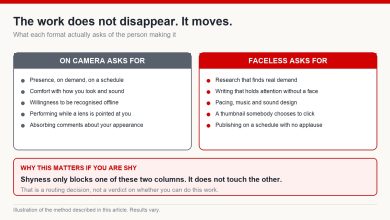
In this line of work – faceless channels aimed at English-speaking audiences in the US, the UK, Germany, Japan – one competent person with a process and current tooling can cover the entire pipeline. Sourcing, scripting, editing, publishing. All of it.
I sometimes say one person can do what used to take a team of fifty. Treat that as my own rule of thumb rather than a measurement: it is how the workload feels once the process is in your head, not a number anybody audited.
But I am not telling you to work alone. I am telling you something more useful: adding people does not automatically add speed. I have watched four-person teams go a full month without producing one decent video while somebody working alone published steadily throughout. The variable is not headcount. It is whether everyone is pulling the same direction, and four people rarely are by default.
What happens when the money finally arrives
Here is the part I do not usually volunteer. Over the years, dozens of the collaborations I have been part of have ended.
The pattern is consistent enough to be boring. Everything is fine while nothing is earned. The moment there is revenue, the questions surface: who contributed more, how do we divide it, why am I doing three jobs. One person decides the other is not a team player; the other decides the first is only in it for themselves.
And some of them I still cannot explain. Two people working well together on Monday, finished by Friday, nobody obviously in the wrong. Different starting points, different assumptions, different taste. One wants the disaster compilation tense and dramatic; the other wants it calm and slow. Force both styles into one channel and you damage both.
I am not telling you this so you avoid collaborating. I am telling you so you walk in with your eyes open instead of assuming that more people means more strength.
The arrangement I have seen hold up
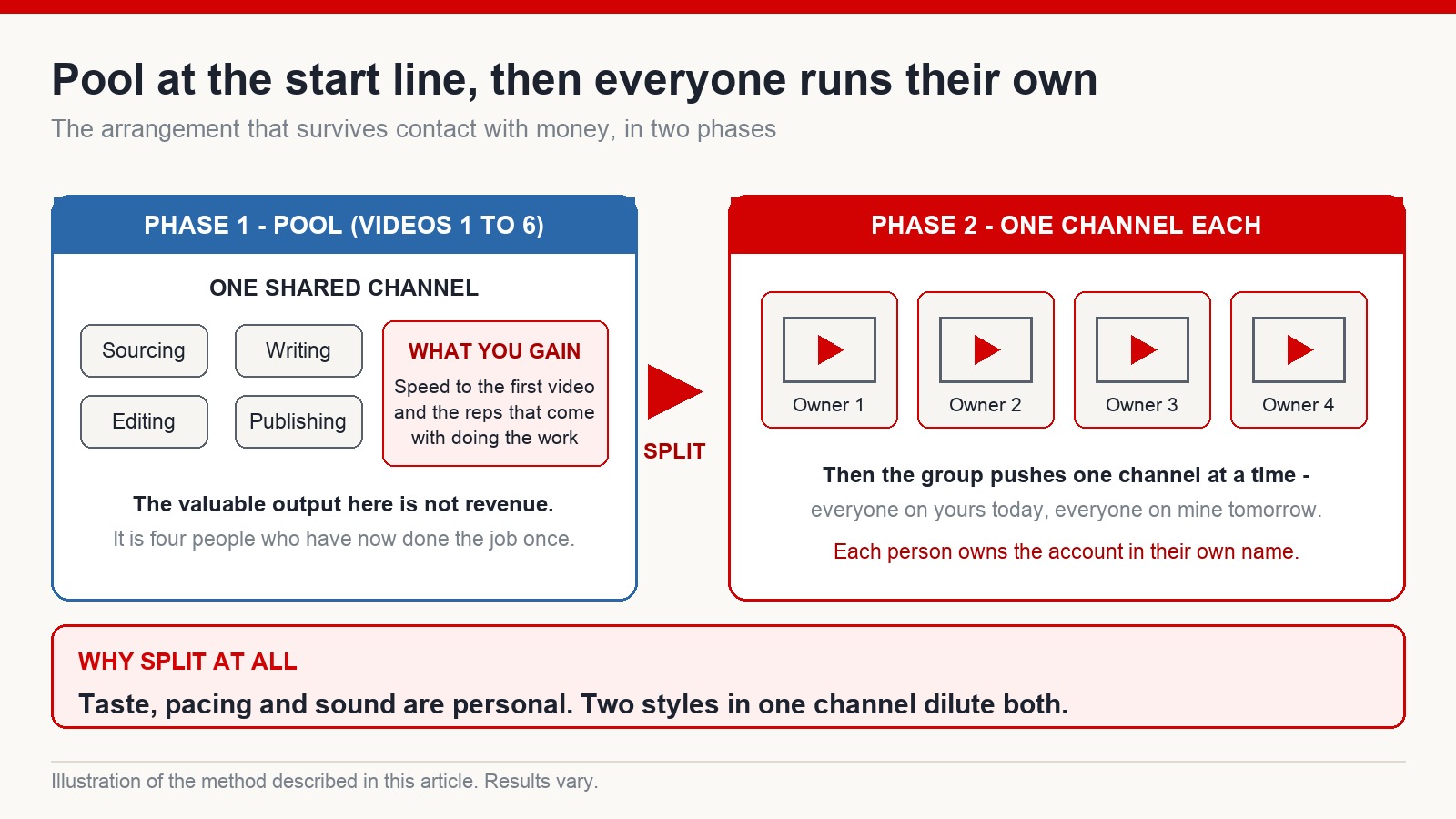
Phase one: pool, to get moving. Four people, one channel, one job each – sourcing, writing, editing, publishing. The goal is speed to the first video and speed to the first real problems. The valuable output of this phase is not revenue. It is four people who have now done the work rather than read about it, and skill only transfers to whoever actually did the task.
Phase two: split at around video four to six. Once the group has that many published, everyone opens their own channel and makes their own videos. Then the group turns outward and pushes one person’s channel at a time – everyone on yours this week, everyone on mine the next.
So the model is not “share a channel forever”. It is one channel each, with mutual support at the start line. And each person’s channel is in their own name, on their own account, which removes most of what people end up fighting about.
Splitting is not a failure of the friendship
People hear “split” and think something went wrong. Nothing went wrong. Over a long run, everyone has their own taste, their own pace, their own sense of what the sound should be. Keep four of those in one channel and you either get a diluted mixture or a standing argument about tone. Neither compounds.
One trap when you split: do not clone into the same market
A common beginner move at this point: take the video that is working and reproduce it on a second channel in the same language and market. It looks like the fastest possible growth. For a beginner it is a trap, because you do not yet know what has to change between the two – so the content ends up too similar, and similar content does not perform.
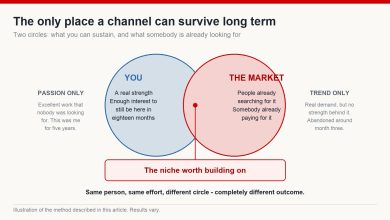
What I suggest instead is replicating into a different market: another language, a different audience. The same underlying idea served to a Japanese audience is a genuinely different video from the one you would make for an American one. Decide which language you are building for deliberately rather than duplicating on autopilot, and make sure each channel has a clear, specific niche of its own – splitting into channels with no distinct niche just dilutes you four ways.
Settle the money while there is none
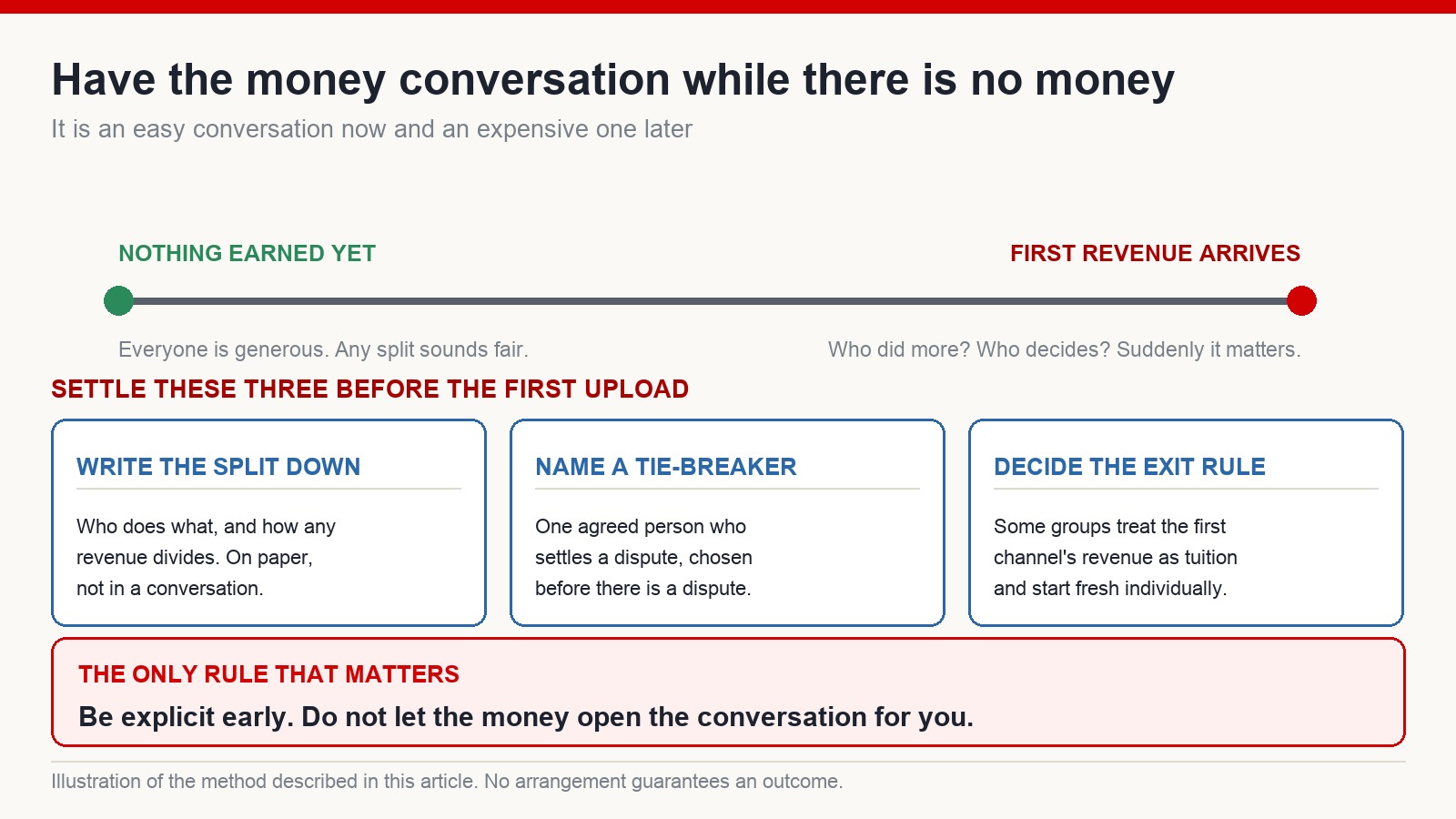
If you do decide to collaborate – which is a perfectly reasonable choice – one rule matters more than the rest: be explicit at the start, while there is nothing to divide.
With no money on the table, everyone is agreeable and every arrangement sounds fine. When revenue appears, the specifics turn out to matter enormously, and by then the conversation is loaded. Write down how work and money divide before the first upload. Some groups pick a clean rule: treat the first channel’s revenue as tuition and start again individually afterwards. Others name one agreed person to settle disputes before there are any. The method matters less than doing it in advance rather than letting the money raise the subject for you.
And to be clear, because this is about money: no arrangement guarantees you earn anything. Team or solo, structure only affects how fast you move. It does not make the work succeed and it does not substitute for doing it.
So – alone, or with people?
My answer: start together, then stand on your own feet. Use the group to get the first video out, to hit real problems quickly, and to get past the paralysis of not knowing where to begin. Then stop using the group as a place to hide, and do not let four people attach themselves to one channel and collectively stall.
I spent nearly five years figuring this out alone, with debts to show for it, before I rebuilt my approach from scratch. If someone had said this to me plainly at the beginning, I would have collected far fewer scars. So I am saying it plainly to you.
If you would rather do the work than read about it, a structured English-language path through building your first channel – guided practice, no promises about views or income – is what I run at mmoyoutube.com. One channel, in your name. That is the sturdiest place to start from.
Is it better to start a channel alone or with a partner?
Both work; they fail differently. Alone, you move at your own pace and own everything, but the first month is lonely and slow. With people, you reach video one faster and learn quicker, at the cost of coordination and eventual disagreement over money. What I would avoid is four people permanently sharing one channel.
When should a group split into separate channels?
Around video four to six, in my experience. By then everyone has done a real job on a real upload, which is the point of pooling. Past that, the shared channel starts absorbing four different tastes and the returns turn negative.
How should a team divide the revenue?
However you like, as long as it is written down before there is any. Two arrangements I have seen work: treat the first channel’s earnings as shared tuition and start fresh individually, or agree percentages by role in advance with one named person to settle disputes. The failure mode is always the same – leaving it until money exists.
Can I copy my working video onto a second channel?
Not into the same language and market, if you are new. You will not yet know what needs to change, the two channels end up near-identical, and near-identical content does not perform. Replicating into another language or audience is the safer version, and each channel still needs its own defined niche.
Whose name should the channel be in?
Each person’s own, which is why I favour splitting early. A shared account with unclear ownership is where partnerships go to end badly – and it is a great deal easier to agree that now, before there is anything attached to it worth arguing over.
Disclaimer: this article describes arrangements I have used and observed. It is not legal or financial advice and it is not a promise of income. If a collaboration involves significant money, put the agreement in writing and get proper professional advice.